

#AIonPoint: How to Choose a Great Spokesperson For Your Brand
.png)
Contents
Lessons from Pizza Hut's Campaign with Tom Brady
Choosing the wrong brand spokesperson doesn't just waste media budget — it can actively damage the brand you've spent years building. An endorsement that feels misaligned, opportunistic, or simply out of touch can generate exactly the kind of coverage no marketing team wants, and the damage tends to stick. Getting it right, on the other hand, can elevate a brand's cultural credibility, deepen loyalty, and drive real purchase intent.
So what does 'right' actually look like? Insights generated with Virtual Audiences in February 2026, sets out a practical framework for spokesperson selection — using one of the most talked-about campaigns of the 2026 Super Bowl season: Pizza Hut's partnership with Tom Brady.
The Campaign: Pizza Hut and Tom Brady
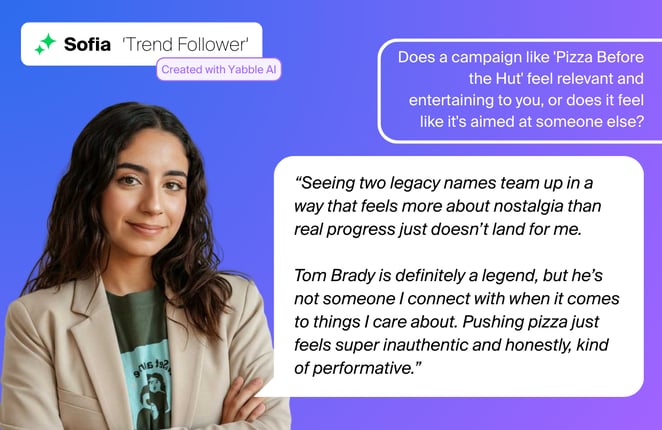
In January 2026, Pizza Hut launched its 'Pizza Before the Hut' campaign for Super Bowl LX season, naming seven-time Super Bowl champion Tom Brady as its global spokesperson.(22) The creative concept was built on a clever piece of NFL trivia: Brady has said 'hut' more than any other player in NFL history.(22) The campaign imagined him taking a job as a pizza delivery driver so he could keep shouting it off the field.(23,24)
The campaign ran across TV, digital, and social platforms, centred on Pizza Hut's 16-inch Big New Yorker pizza at $10. An interactive element invited fans to get their own team's quarterback to say 'pizza' before 'hut' during a live game, with a free pizza party for the winning city on the line.(22,23)
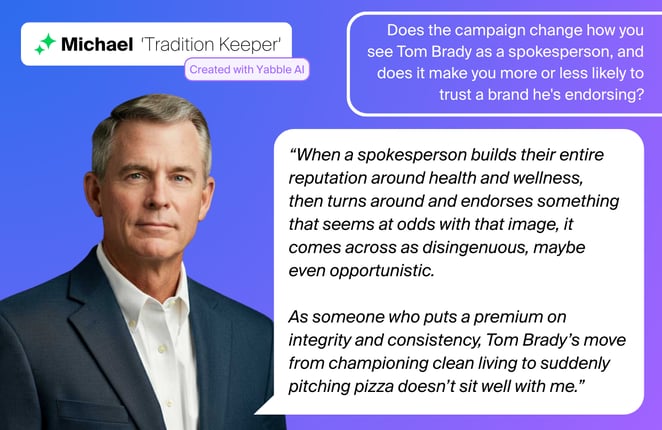
The concept was clever and the hook was obvious. But it ran immediately into a credibility problem. Brady spent his entire playing career publicly championing the TB12 Method — a strict, heavily publicized approach to clean eating. Fans were quick to notice the contradiction, and the authenticity question became part of the public conversation about the campaign.(25) It's a useful case study precisely because the tension is so visible: strong creative execution, genuine values misalignment.
1. What Consumers Want from a Spokesperson
Above everything else, consumers want relatability and trust. Relatability comes from shared values, an approachable style, emotional openness, and cultural relevance. Trust comes from a credible background, consistency across platforms, and a relationship with the product or cause that feels genuine rather than transactional.(2)
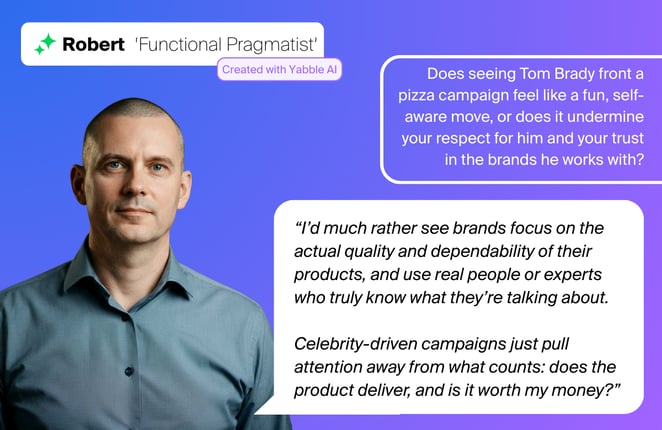
Published research consistently identifies authenticity as the foundation of effective spokesperson relationships. Consumers are more likely to trust someone who feels like a peer than someone who feels like an advertiser — and any undisclosed or obviously commercial relationship erodes that trust quickly.(20) Research also identifies attractiveness as the most influential individual attribute in spokesperson effectiveness, though its role varies: for male influencers, trustworthiness drives brand awareness most strongly, while for female influencers, attractiveness plays a more prominent role.(21)
Cultural alignment matters too. Consumers are more loyal to brands whose identity reflects their own values, and that emotional connection is what drives word-of-mouth advocacy.(12) A spokesperson who embodies those values acts as a bridge between brand and audience. One who contradicts them becomes a distraction.
2. Spokesperson Expectations Vary Between Audiences
Different audiences bring fundamentally different expectations to brand relationships, and those differences are well documented. Baby Boomers tend to prioritise simplicity and family values. Gen X responds to functionality and value for money. Millennials are drawn to lifestyle and sustainability signals. Gen Z is most focused on identity, self-expression, and ethical consumption.(15)
These aren't just demographic footnotes — they're directly relevant to spokesperson selection. For Gen Z and Millennials especially, a spokesperson's social media presence and the brand's underlying values carry significant weight.(13) A partnership that feels authentic to one generation can feel hollow or performative to another.
Representation matters too. Research finds that 66% of consumers implicitly support diversity, equity, and inclusion even if they don't express it openly,(17) and 11% of US consumers report never seeing their ethnicity represented in advertising.(14) Those are meaningful signals about where brands have room to build deeper connection through more inclusive casting.
3. The Effects of a Spokesperson
The history of spokesperson campaigns offers a clear pattern: the ones that succeed are built on authentic alignment; the ones that fail usually aren't.
L'Oréal's partnership with Viola Davis is a well-cited positive example — the fit between spokesperson and brand felt natural, it enhanced cultural credibility, and it broadened the brand's relevance in a way that felt earned rather than calculated.(11) Converse has similarly strengthened purchase intention through charismatic spokesperson choices where the cultural connection was obvious.(10)
The cautionary examples are equally instructive. United Airlines suffered when its CEO's crisis response was perceived as insincere — the gap between what was said and what consumers expected destroyed trust rapidly.(4) PepsiCo's Kendall Jenner advertisement, widely seen as trivialising the Black Lives Matter movement, caused significant and lasting reputational damage.(4) The consistent lesson across failures is that authenticity cannot be faked, and accountability cannot be avoided.(4)
4. A Framework for Choosing the Right Spokesperson
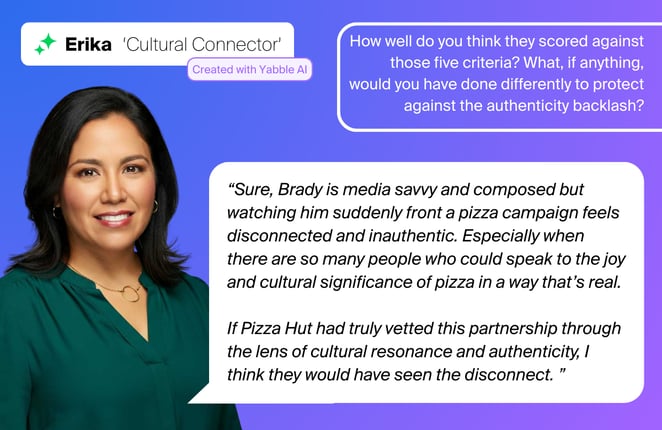
Research points to five core selection criteria that, taken together, provide a practical pre-partnership checklist:
- Authenticity and relevance. The connection between spokesperson and brand must feel natural, not engineered. Genuine enthusiasm for the product or cause is detectable — and its absence is equally obvious.(1,5)
- Value alignment. The spokesperson's personal values should reflect both the brand's mission and the target audience's beliefs. Misalignment here — as the Brady campaign illustrates — tends to surface publicly and quickly.(12,15)
- Composure and media savvy. They need to handle public scrutiny and difficult questions with confidence. A spokesperson who creates their own controversy is a liability.(5)
- Demographic resonance. Age, gender, cultural background, and geography all affect how a spokesperson lands with a specific audience. The right fit for one segment may be the wrong fit for another.(7)
- Thorough vetting. Reputational risks — including potential value mismatches, past controversies, and the way a spokesperson's existing public identity might interact with your brand — should be assessed before any partnership is formalised.(12,13,20) This is the step most often abbreviated under time pressure, and the one that tends to produce the most avoidable problems.
5. One Spokesperson or Many?
The structural question underneath all of this is whether brands should concentrate their spokesperson investment in a single face or distribute it across a portfolio.
Research favours the portfolio approach. Multiple spokespeople with diverse expertise enhance credibility across different audience segments, allow messaging to be tailored by platform or demographic, increase media reach, and reduce concentration risk. Companies with trained spokesperson teams tend to generate more positive media coverage.(6) When one partnership runs into trouble, the brand isn't wholly exposed.
A single spokesperson, by contrast, creates stronger brand consistency and a cleaner narrative — but concentrates reputational risk in one individual. If their values are called into question, the brand's are too.(6)
Pizza Hut's own campaign structure is instructive here. Alongside Brady, the brand ran separate holiday campaigns featuring Josh Allen(23) — a younger, differently positioned NFL figure who appeals to a distinct audience segment. That dual approach was a form of portfolio thinking in practice: Brady for the legacy-and-recognition play, Allen for a fresher, more contemporary resonance.
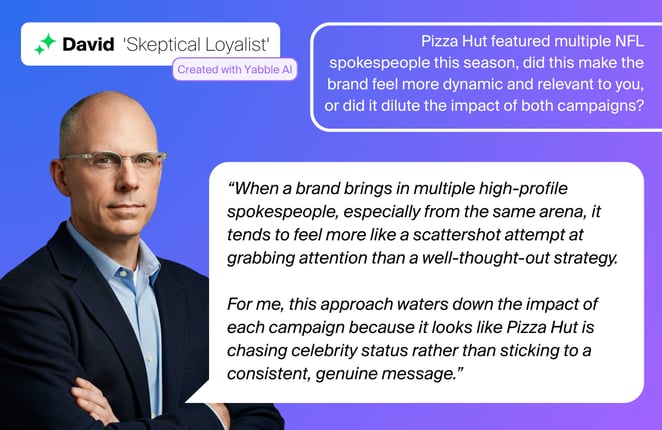
Key Takeaways
Effective spokesperson selection comes down to a discipline most marketing teams already know in theory but compress under deadline pressure: rigorous pre-partnership vetting that treats authenticity and value alignment as non-negotiable, not as factors to be weighed against reach and name recognition.
The Pizza Hut and Brady campaign is a useful illustration precisely because it wasn't a straightforward failure. The creative concept worked. The media coverage was substantial. But the authenticity backlash was foreseeable — Brady's clean-eating identity had been central to his public brand for over a decade. A proper values audit conducted before the partnership was formalized should have surfaced that tension and forced a deliberate decision about how to handle it, rather than leaving the response to ad hoc press management.
Two practical implications follow. First, always map a proposed spokesperson's existing public identity against your brand's values positioning before signing — not as a box-ticking exercise, but as a genuine stress test of how their personal narrative will interact with yours across different audience segments. Second, if you're using a portfolio approach, make sure the logic of each choice is clear enough to stand on its own. Differentiation has to be real, not just nominal.
Understanding how specific audience segments will process a spokesperson choice — before launch, not after — is what separates campaigns that land from campaigns that generate the wrong kind of conversation.
For a closer look at how Virtual Audiences can help brands to monitor audience perceptions and pressure test scenarios before they become real, book a demo here.
Each post in #AIonPoint: Market Insights for Brands explores the trends and consumer behaviors shaping your industry. From retail and CPG to tech, we’re uncovering what truly drives markets, all powered by our synthetic data solution that’s fast, accurate, and always on point. Stay tuned for more insights and trends as Yabble AI decodes consumer behavior, helping brands thrive in an ever-changing landscape.
References:
1. https://www.sciencedirect.com/
11. https://www.brandingmag.com/
12. https://www.researchgate.net/
16. https://rankings.newsweek.com/
18. https://www.forrester.com/
20. https://www.emarketer.com/
22. https://www.prnewswire.com/
23. https://www.marketingdive.com/